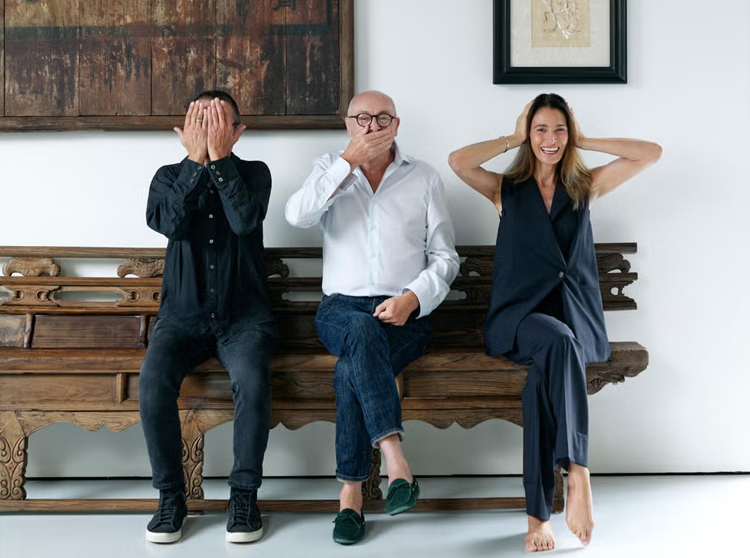
A client, an architect, and a project for a home-studio in Pietrasanta , a characteristic village in Versilia . Nothing unusual so far, except that the two protagonists of this project are a Milan-based couple who decided to create a quiet oasis here, far from their city home. And if we didn’t point out that one is Veronica Gaido , a visual artist, and the other is Piero Lissoni , head of the renowned interdisciplinary design firm Lissoni & Partners . It’s clear how the boundaries of the professional assignment blur in collaboration, reflecting a lively dialogue between art and architecture: ” It was a four-handed project ,” they confirm in unison. Like the three wise monkeys of the Shinto shrine of Nikko (Japan), the three protagonists of this service pose in an irreverent selfie sitting on an ancient oriental bench: from the left the photographer Tommaso Sartori (I can’t see), and the owners of the house, the designer Piero Lissoni (I can’t speak) together with his wife, the photographer Veronica Gaido (I can’t hear).
“We shared a common goal from the very beginning, oriented toward a non-traditional space.” Indeed, approximately two years after the delicate restoration and modernization of a marble artisan’s workshop began, the interior still retains its original industrial atmosphere. This is accurately captured in the photographs of Tommaso Sartori , the third link in this story of intertwined relationships. “The shoot for Elle Decor is a reflection on our professional relationship and on all the projects Piero has assigned me as creative director over the years,” says the photographer, known for his sensitive interpretations of design and architecture.
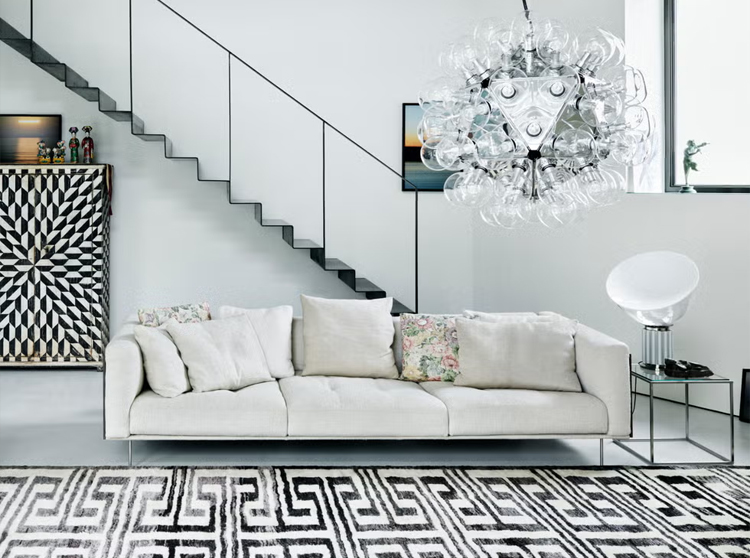
A glimpse of the living room with the Rod sofa, Living Divani, on the Moroccan rug. A Taraxacum lamp, Flos, is strikingly mounted on a metal hook.
“Respect for each other’s work and ideas, along with mutual trust, are, I believe, the most important elements. I’m grateful to Piero because he’s always given me great freedom of expression. This rarely happens, especially when the idea is to create a company’s image and not just take product photographs.” A bond developed over three decades, spanning countless catalogs and advertising campaigns for major Italian brands and reportages of buildings around the world. “When we work together, I tell what I’d like to see through his eyes. Tommaso tells through his photographs what he sees through mine,” Lissoni has no hesitation in stating, almost in return. He adds: “The key is the same approach: we’re both anarchic and highly disciplined , and we have a great desire to do research. I appreciate his handling of light, how he frames his shots, and how he chooses still lifes within a story.”
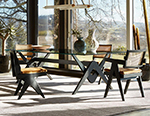
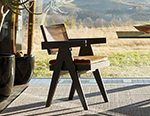
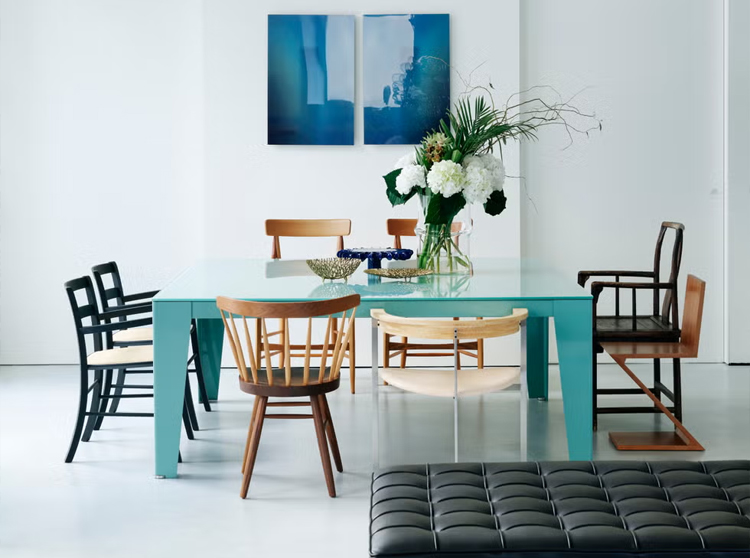
In the dining area, around the Tablo table, with a metal frame and back-painted glass top, by Piero Lissoni for Porro, are different chairs. The black M16 chairs with armrests by Piero Lissoni for DePadova are the traditional N19 Straight Chair by George Nakashima, Knoll. The three-legged PK 11 by Poul Kjærholm, Fritz Hansen. On the right: the Zig Zag chair by Gerrit Thomas Rietveld, Cassina, and an antique Chinese wooden armchair.
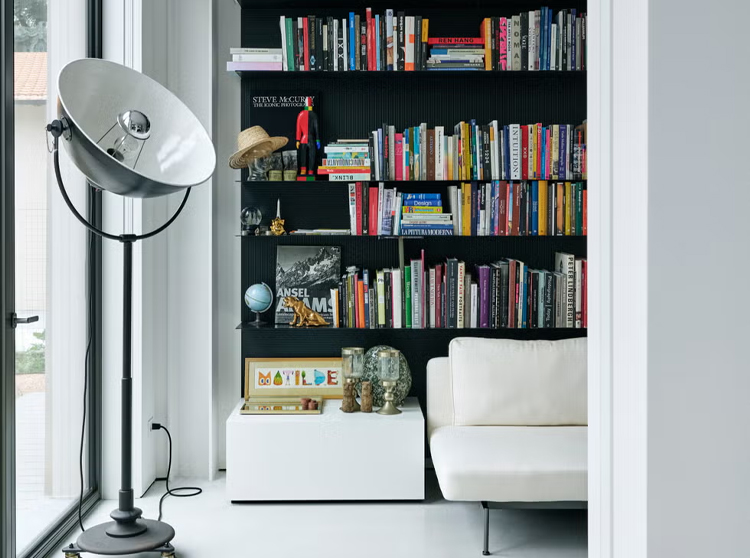
The study, the heart of the Pietrasanta home. Floor lamp by Mariano Fortuny, Pallucco. Custom bookcase by Porro. Saké sofa by Piero Lissoni for B&B Italia.
“We’ve divided our library in two. Here in the studio are what we might call ‘designed culture’ books: professional, architecture, design, and fashion, also created by Veronica. The upper rooms, on the other hand, house more personal readings.” An organic blend, constantly evolving, discernible wherever you look, always captivated by the constant comparisons, in which furnishings designed by Lissoni himself are juxtaposed with the icons of previous masters. Gaido’s acute photographs are juxtaposed with the art of the past. And with each other. It’s like living—as they put it—“in a catalogue raisonné, driven by quality.” And with the intensity of a mutual exchange.