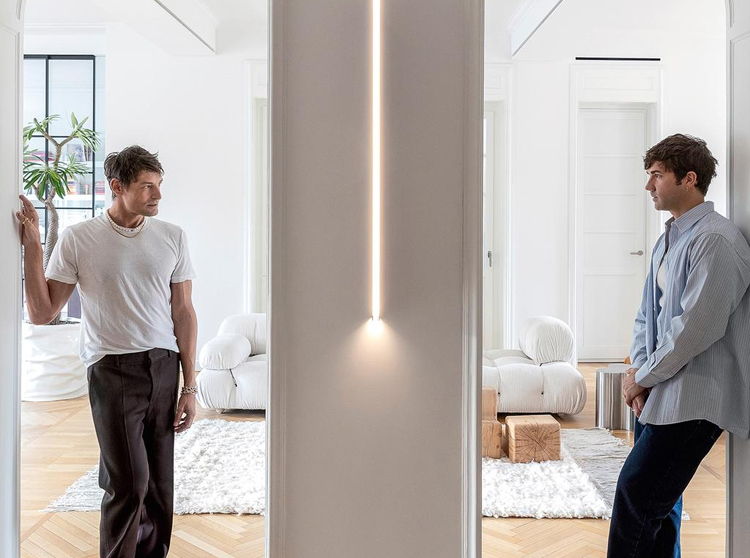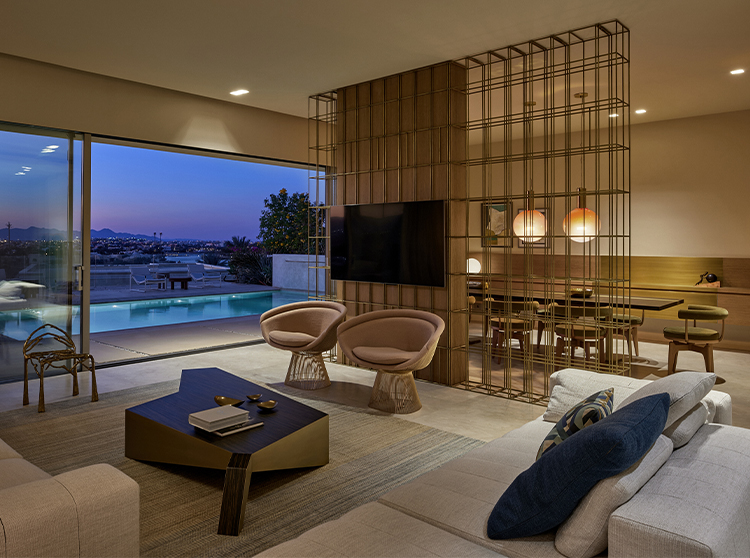
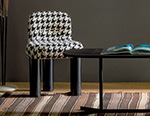
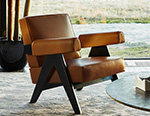
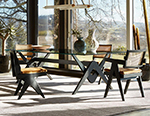
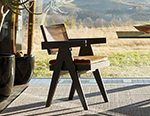
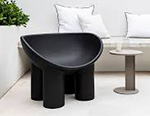
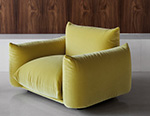
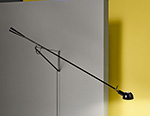
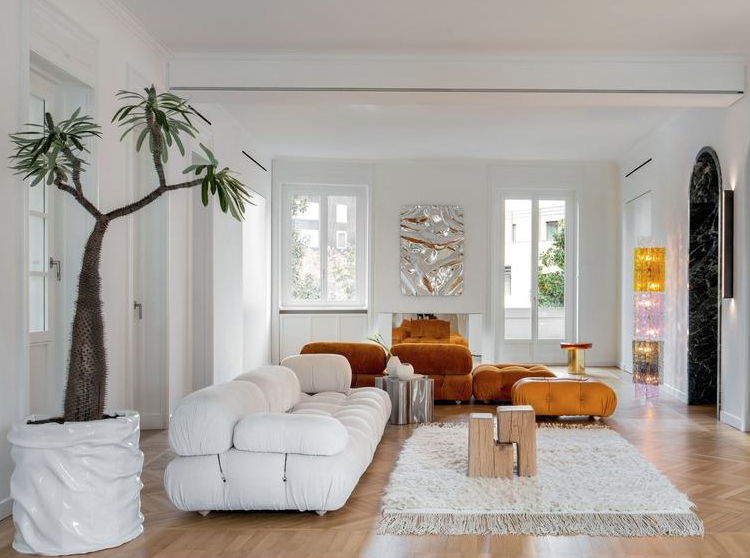
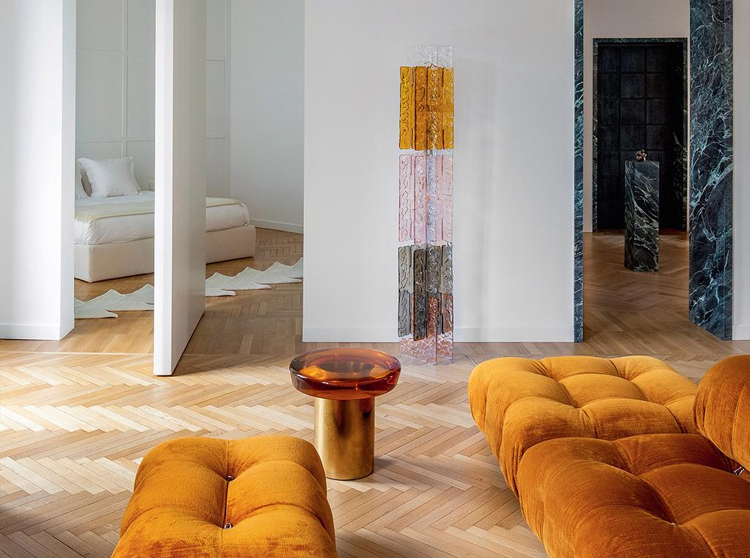
In the living room, Camaleonda sofas and ottomans by Mario Bellini from B&B Italia, enquiries to Space Furniture; Destroyers/ Builders side table by Linde Freya Tangelder from Carwan Gallery; Silver Root side table from Caia Leifsdotter; resin vase from Studio X; rug from Cc-tapis, enquiries to Mobilia; Madagascar palm plant sculpture by Derek Castiglioni.
In his beloved masterpiece The Little Prince, author Antoine de Saint-Exupéry wrote: “It is only with the heart that one can see rightly; what is essential is invisible to the eye.” This is the passage Alessandro Filippo Ficarelli and Francesco Terzo recall while discussing their Milan home. “What we wanted for the house is intangible; a feeling, an emotion, something that is not visible, like love.” Terzo and Ficarelli are the creative directors of Pandora, the Danish jewellery brand that wraps charm bracelets around wrists globally. The polymathic duo divide their time between Copenhagen for work (Pandora’s headquarters is in the Danish capital) and Milan, an arrangement that allows them to “capture the energy of both”, and yet the way Terzo describes Milan reveals a deeper desire to build a life there. “Milan is the city that adopted us. We found a natural connection, a comfort zone, a space where our creativity can flourish.”
In another view of the living room with views of the main bedroom and entry, resin side table by Draga & Aurel; Lina Totem glass lamp by Hannes Peer.
So intuitive is the design of this home that the journey from one room to the next feels as though it has been curated. That impression is deepened by the many artworks displayed on walls and stone plinths, though to label it a gallery is to miss the point. Says Terzo: “Each piece has been chosen and positioned in a way that means a lot to us. We like how the artworks complete the space, and how the space highlights the artworks. It’s not an installation.” There is a sensitivity and desire for connection that guides every decision Terzo and Ficarelli make whether it’s a new home or a new artwork, and they are drawn to “young international artists” who share a similar creative attitude. “This is more a community approach than a collector approach,” Terzo explains. “We find artists that have a specific point of view with materials. We love knowing the artists… and we love a sculptural approach.”
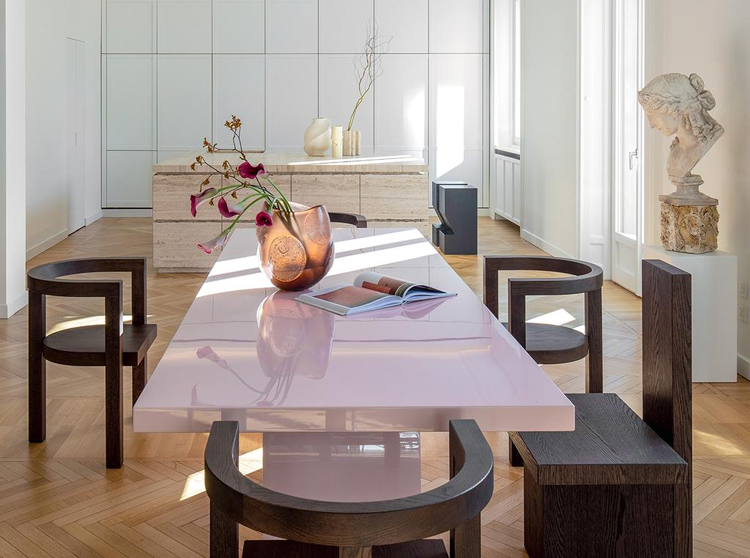
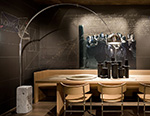
In the dining and kitchen area, custom Arco dining table in pink gloss lacquer by Henry Timi; Cerchia chairs and Immacolata chair, all from Henry Timi, enquiries to Vboaustralia; glass vessel (on table) from Micheluzzi; Il segno del tempo 19th century Dionysus sculpture.
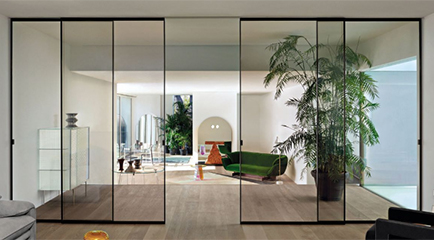
The pair were so taken by these features they constructed a third in green marble. The year-long renovation, in Terzo and Ficarelli’s words, was an extension of their creative selves. “We are not linear, we live in flux. We are a work in progress,” Ficarelli declares, and as a result, their home has a chameleon-like quality that transforms according to the occasion. Like enchanted rooms of requirement, spaces are revealed, concealed and integrated via “spinning doors and theatrical curtains”. Take the home studio as a case in point. Framed glass doors separate the studio from the dining area, in the centre of which is a custom lacquered table by designer Henry Timi. When the doors are open, the space becomes a convivial hub within reach of the kitchen. When the doors are closed and Terzo and Ficarelli entertain around the glossy pink dining table, the studio’s intimacy is restored and guests can’t help but steal a look through the glass, as if peering into the pair’s psyche.
Under Ficarelli and Terzo’s direction, the limits of that sculptural approach have been pushed to extraordinary proportions. Henry Timi, who Ficarelli describes as “a visionary and a material expert”, created many of the stone artworks, as well as the monolithic kitchen island and the bathroom scoured head-to-toe in travertine with a freestanding marble shower so divine it could turn bathing into a spiritual experience. The ceremony of museums and churches also inspired what Terzo calls The Lighting Project. Architect Salvatore Massone, who “created the final cut of the house”, collaborated on The Lighting Project, which embraces the way natural and architectural lighting can breathe life into a room and create drama, going “far beyond arranging light fixtures”. Light, art, movement, material — these elements are essential to Ficarelli and Terzo’s work, but what’s invisible to the eye is the alchemy in their partnership. “We have a common vision. We believe in dreams and magic.”